The Death of the Sales-Guy CEO: Why Technical Founders Are Inheriting the Enterprise Software Boom

For over two decades, the blueprint for scaling an enterprise software giant in Silicon Valley followed a reliable, time-tested archetype. A visionary founder would build the initial product, but once the company reached a critical inflection point, the board of directors would step in to install a seasoned corporate operator—typically a career sales executive. This professional CEO would install a ruthless, repeatable sales machine, scale distribution, and drive the firm to an initial public offering and multibillion-dollar valuations.
No figure exemplifies this historical standard better than Frank Slootman. As the only chief executive officer in technology history to successfully take three major enterprise software firms public—Data Domain, ServiceNow, and Snowflake—Slootman presided over companies that commanded more than $200 billion in combined market capitalization at their peaks. Under his leadership, ServiceNow scaled from approximately $100 million in revenue to $1.4 billion through its IPO. Later, coming out of retirement in April 2019, he steered Snowflake from a $4 billion valuation to the largest software IPO ever recorded.
Yet, a closer examination of Slootman’s professional history reveals a nuance often overlooked in tech lore: he never actually worked as a traditional quota-carrying sales representative. His background was rooted in product management, general management, and engineering oversight, holding roles at Compuware, Borland, and Uniface before stepping into his first chief executive seat. His reputation as a master of sales was earned through his rigorous operational management style, not a lifetime of carrying a bag. Similarly, Marc Benioff, another titan of the software-as-a-service (SaaS) era, spent years mastering product, marketing, and engineering before founding Salesforce, having written assembly code for Apple’s Macintosh division during his college years.
Today, however, the foundational leadership paradigm of the software industry is undergoing a profound structural shift. A comprehensive analysis of the fastest-growing business-to-business (B2B) and artificial intelligence enterprises reveals a striking departure from the past: the era of the default sales-led executive is giving way to technical, engineering-first, and domain-expert leadership.
The Shift in Leadership Demographics
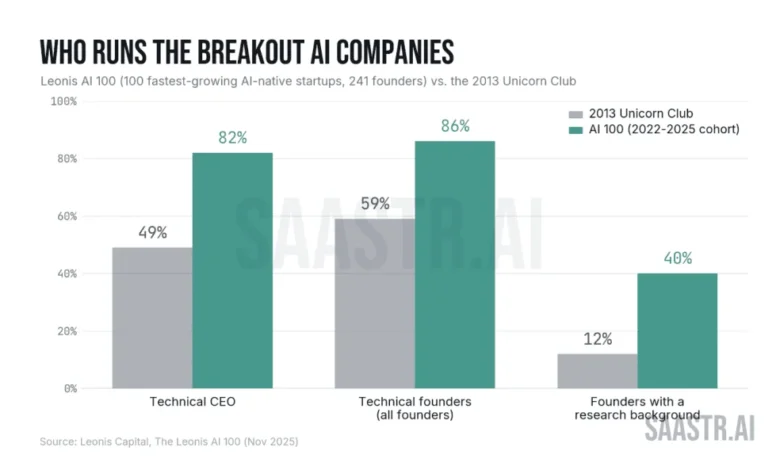
Recent index data compiled by venture capital firm Leonis Capital, which tracked more than 10,000 artificial intelligence startups between 2022 and 2025, underscores this macro-level transition. Among the 100 fastest-growing AI-native companies identified in the study, 82 are led by technical chief executive officers, with 86 percent of total founders holding technical backgrounds.
This contrasts sharply with historical benchmarks, such as Aileen Lee’s original "Unicorn Club" cohort from the previous decade, where only 49 percent of companies featured a technical CEO and 59 percent of founders were technical. Furthermore, the presence of deep academic and research pedigrees has surged. Approximately 40 percent of the AI 100 founders possess formal research backgrounds—hailing from institutions like DeepMind, OpenAI, and University of California, Berkeley—compared to just 12 percent in the previous unicorn generation. These modern founders are also markedly younger, with a median founding age of 29, often transitioning straight from academic and corporate labs into entrepreneurship without spending a decade climbing the traditional corporate management ladder.
This demographic transformation is clearly visible across market-leading private and public firms. Databricks, Replit, Harvey, Fireworks AI, Sierra, Decagon, Abridge, and OpenEvidence are helmed almost entirely by computer scientists, researchers, and domain experts rather than career commercial executives.
The Databricks and Snowflake Case Studies
The strategic implications of this leadership evolution are best illustrated by contrasting two data infrastructure giants that emerged from the same technical category: Databricks and Snowflake.
In January 2016, Databricks faced a critical juncture. Having raised approximately $174 million at a roughly $1 billion valuation, the company was generating negligible revenue as major cloud providers like Amazon Web Services and Cloudera began absorbing Apache Spark into their own native offerings. Founding CEO Ion Stoica agreed to step down to return to his professorship at UC Berkeley.
The conventional playbook dictated bringing in a seasoned, sales-oriented Silicon Valley operator—a strategy that Snowflake successfully deployed on its path to a multi-billion-dollar valuation. Instead, Databricks co-founders championed Ali Ghodsi, then serving as Vice President of Engineering and a career academic with no prior business-running experience. Early board members, including Ben Horowitz of Andreessen Horowitz, initially questioned the wisdom of swapping one founder-professor for another, leading the board to approve a cautious one-year trial.
That trial yielded transformative results. By August 2026, Databricks announced a $5 billion funding round at a staggering $190 billion valuation, expanding at over 80 percent year-over-year while servicing more than 1,000 customers spending upwards of $1 million annually. Ghodsi ultimately opted to delay public market debuts, allowing the company to scale as a private entity. By comparison, while Snowflake remains a formidable market presence, industry analysts note that the firm that retained its academic-turned-technical leader scaled to exceptional heights.
The operational dynamics were further highlighted when Snowflake itself transitioned leadership. On February 28, 2024, Snowflake announced that Slootman was retiring and that Sridhar Ramaswamy, a computer scientist who previously scaled Google’s advertising business from $1.6 billion to over $100 billion and founded AI search startup Neeva, would assume the CEO role. The immediate market reaction was severe, with Snowflake’s stock dropping 20 percent in a single session amid investor concerns that the departure of a master sales operator would stunt growth.
Yet, under Ramaswamy’s engineering-centric stewardship, Snowflake’s operational metrics rebounded. The company achieved record-breaking sequential dollar growth, with net revenue retention stabilizing and remaining performance obligations surging. Rather than treating go-to-market execution as a secondary concern, Ramaswamy spent his initial tenure systematically rebuilding Snowflake’s sales organization into an AI-native apparatus, approaching commercial strategy with the rigor of a software engineering problem.
The Rise of Domain-Expert Founders
Beyond pure software engineers, the modern enterprise landscape has given rise to a third distinct category of leaders: domain experts whose deep, first-hand professional experience intersects directly with newly viable artificial intelligence capabilities.
Harvey, an AI platform for legal workflows valued at $11 billion, is led by Winston Weinberg, a former junior attorney at O’Melveny & Myers who experienced firsthand the document-heavy, mechanical tasks that the software now automates. Abridge, valued at over $5 billion, was founded by Dr. Shiv Rao, a practicing cardiologist who still maintains clinical duties one week a month, bridging the gap between healthcare administrative burdens and ambient clinical documentation. OpenEvidence, commanded by Harvard PhD and Kensho founder Daniel Nadler, similarly leverages deep domain alignment.
According to Leonis Capital’s data, nine out of 13 vertical AI founders in their index possessed direct, pre-existing sector experience. This intimate familiarity with specific industry workflows enables technical and domain-expert founders to evaluate capabilities rapidly, circumventing the lengthy ramp-up times typical of traditional corporate operators.
The Resilience of the Commercial Playbook
Despite the ascendancy of technical leadership, the traditional commercial chief executive remains a potent force in enterprise software. ServiceNow continues to demonstrate the enduring viability of the sales-led playbook under the leadership of Bill McDermott.
McDermott, whose extensive executive background spans leadership roles at Xerox, Gartner, Siebel Systems, and a 17-year tenure at SAP, represents the archetype of the commercial P&L executive. In its second-quarter financial report for fiscal year 2026, ServiceNow posted subscription revenue of $3.877 billion—a 24.5 percent year-over-year increase—alongside robust operating margins and surging annual contract values for its artificial intelligence offerings. McDermott’s performance metrics consistently reflect the efficacy of a disciplined, globally scaled sales organization.
However, market valuations and investor sentiment surrounding commercial-led firms have experienced increased volatility, reflecting a broader shift in how public markets underwrite software growth. While commercial operators excel at multiplying a proven product through aggressive distribution, modern investors increasingly prioritize underlying technological adaptability and product-led growth velocity.
Agility, Pivots, and Speed to Market
A critical advantage demonstrated by technical chief executives is organizational agility. Data indicates that technical-led AI startups pivot their product strategies within a median timeframe of 12 months, compared to 27 months for companies managed by non-technical counterparts. In a fast-moving technological landscape where foundational model capabilities evolve rapidly, a 15-month lag in recognizing and executing strategic shifts can determine market leadership.
For instance, coding assistant platform Cursor was initially developed as AI-powered computer-aided design (CAD) software for mechanical engineers. Upon gaining early access to advanced frontier models, the technical founders recognized the model’s superior coding capabilities within minutes, abandoning months of prior development to pivot the entire enterprise. Such instantaneous strategic realignment requires leadership capable of directly evaluating underlying models rather than relying on commissioned market studies.
Furthermore, over 80 percent of modern high-growth AI startups launch with self-serve onboarding models. Sales functions are integrated downstream to formalize existing organic demand, meaning traditional sales-manufacturing CEOs are optimizing the secondary phase of go-to-market execution rather than the initial product-market fit discovery.
Implications for Founders, Boards, and Enterprise Leaders
As the enterprise software landscape matures, this leadership shift carries clear implications for industry stakeholders:
- For Founders: Executives who cannot directly evaluate foundational technology run the risk of lagging behind critical product pivots. Leadership must either maintain close proximity to core technical developments or empower technical co-founders to dictate strategic direction.
- For Boards of Directors: Successful transitions at firms like Databricks and Snowflake demonstrate that technical leaders can successfully master commercial execution. Promoting leaders with deep product comprehension—provided they take ultimate ownership of revenue metrics—proves highly effective in navigating complex technology cycles.
- For Sales Leaders: The mandate for skilled commercial operators remains immense, but the reporting lines have evolved. Modern Chief Revenue Officers increasingly report to technical chief executives who understand the intricacies of model architecture and product deployment.
Ultimately, the software industry is not abandoning sales discipline; rather, it is restructuring it. As Frank Slootman’s continued engagement as an investor in next-generation AI infrastructure suggests, the market has recognized that the future belongs to enterprises that combine engineering excellence with world-class commercial execution—with the technologist firmly at the helm.